
The RuGGe project (Russian in Germany across Generations) was a comprehensive sociolinguistic study at the University of Konstanz, funded by the German Research Foundation (DFG), examining the development, maintenance, and transmission of the Russian language in Germany. By analyzing three generations, the research provided a unique perspective on how heritage languages evolve in a migration context.
Research Objectives
The project aimed to identify the factors influencing language retention over time. The primary areas of focus included:
- Linguistic Change: Documenting structural shifts in the Russian language across different age cohorts.
- Language Maintenance: Analyzing why certain participants continue to use their heritage language and identifying the variables that influence language stability or change.
- Intergenerational Transmission: Investigating the social and familial mechanisms used to pass language across three generations, from grandparents to parents and children.
Participant Profiles
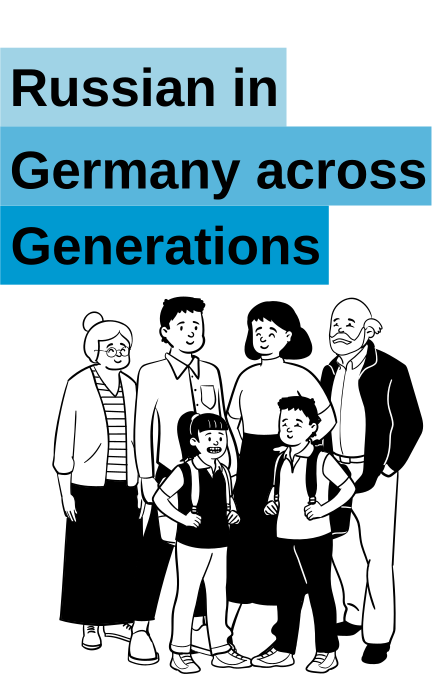
The study involved 20 families, allowing for the analysis of linguistic patterns across three generations at the same time. Adult participants (parents and grandparents) emigrated to Germany primarily from Russia, Kazakhstan, Ukraine, and Uzbekistan.
| Generation | N | Sex (f/m) | Age Range | Age at Arrival |
|---|---|---|---|---|
| Children | 29 | 16 / 13 | 7 – 17 | 0 (born in Germany) |
| Parents | 35 | 20 / 15 | 37 – 56 | 10 – 33 |
| Grandparents | 22 | 13 / 9 | 59 – 78 | 35 – 53 |
| Total | 86 | 49 / 37 | 7 – 78 | 0 – 53 |
Methodology & Research Instruments
The study employed an extensive battery of tests to evaluate participants' linguistic competence across various domains. Data collection was conducted through both remote sessions and in-person meetings.
1. Linguistic Test Battery
Our assessment covered the core components of language proficiency:
- Lexicon: Vocabulary was tested through color terminology (goluboj-sinij distinction), "Kitchen Russian" (everyday household objects), and semantic Verbal Fluency Tasks.
- Syntax & Morphology: We evaluated structural accuracy using Grammaticality Judgment Tasks, Cloze tests, and Sentence Repetition Tasks. Additionally, specialized Picture-Naming Tasks were used to measure the proficiency of gender and case agreement,
- Phonetics: Word stress and phonological accuracy were measured through specialized picture-naming tasks.
2. Narrative & Discourse
To assess language use in context, participants performed narrative tasks:
- "Frog, where are you?": A standardized storytelling task based on visual prompts.
- "My Day": A description of daily routines to evaluate spontaneous speech, grammar, and narrative structure.
3. Sociolinguistic Context
To provide a deeper context for the linguistic data, we gathered qualitative insights through:
-
Biographical Questionnaires: Documenting migration history, educational background, and language exposure, while exploring individual attitudes toward the Russian and German languages and patterns of language use across different social domains.
-
Sociolinguistic Interviews: In-depth conversations regarding family migration history and language use, exploring the participants' cultural and national identities alongside their unique bilingual profiles.
Funding
This research was made possible by the support of the German Research Foundation DFG — Project Number: 445288386.
